EGCA Consulting

EGCA Value Proposition

EGCA value proposition overview — execution-based consulting that delivers measurable operational improvements.

Contents25 pages

EGCA Value Proposition — read it as text

A full text version of the magazine above — who we are, our services, team, clients, approach, case studies and how to reach us.

Introduction

Overview

We are the go-to consulting firm for execution-based problem solving that delivers real value.

We take on complex operational challenges and work alongside our clients to deliver measurable improvements in performance.

We do not pursue work that lacks substance or impact.

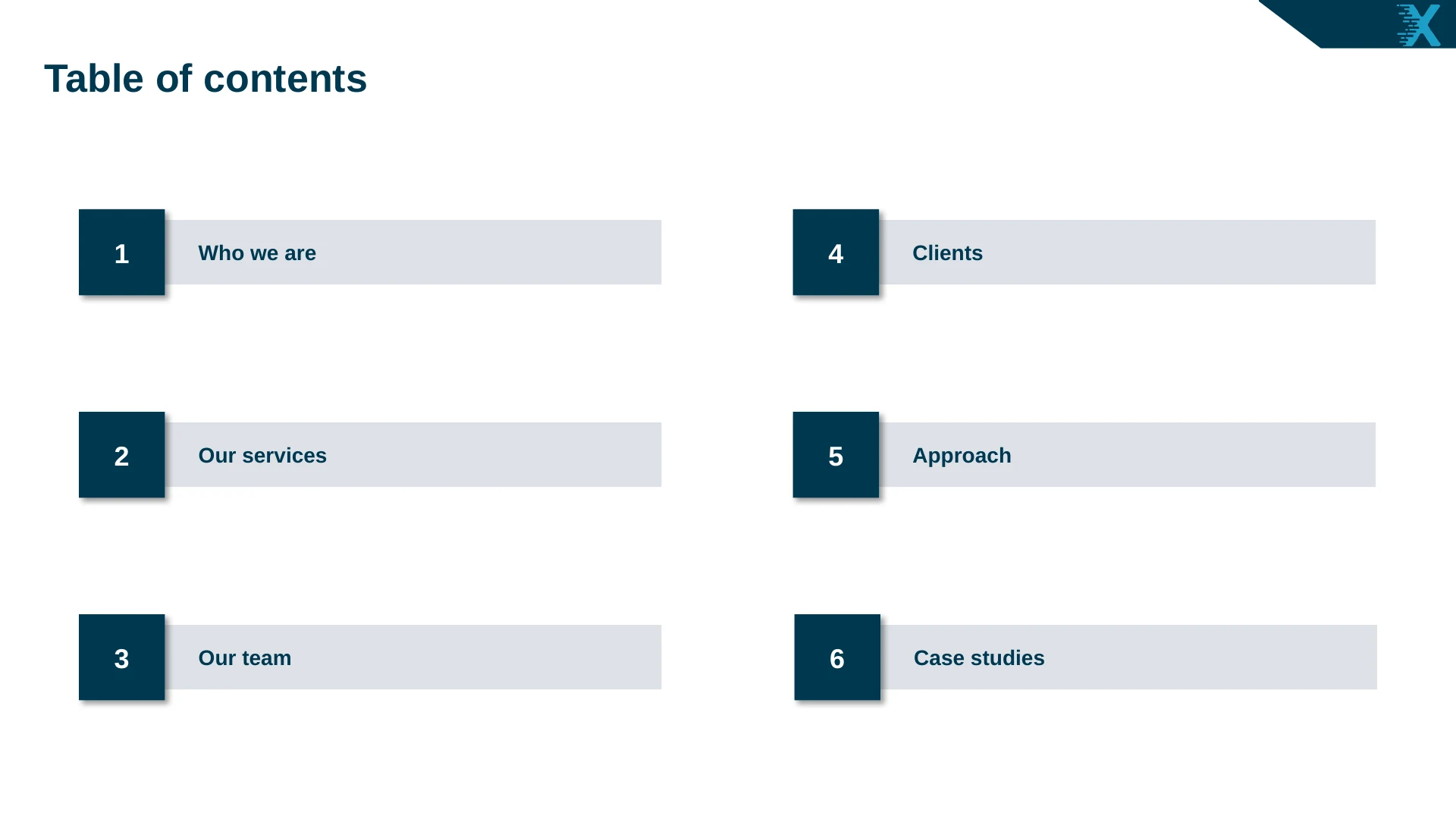
Table of Contents

  • 1. Who we are
  • 2. Our services
  • 3. Our team
  • 4. Clients
  • 5. Approach
  • 6. Case studies

Who We Are

Who Are We?

EGCA is a world-class consulting firm dedicated to providing simple solutions to complex problems, and to delivering tangible return on investment for our partners.

We work across mining; processing, oil & gas; construction; manufacturing, pulp & paper; logistics & supply chain; and financial services.

  • 30+ successful consulting clients, including 4 successful projects for Impala.
  • Successfully operating in the mining industry since 2007.
  • $100m+ per annum in bottom-line cost reduction and throughput improvements.

Our Services

Eight Areas of Value Creation

EGCA supports clients across eight main areas of value creation:

  • Continuous Improvement — increase revenues, reduce costs and improve operational efficiency (unit cost reduction).
  • Procurement and Supply Chain — optimise supply chains and procurement for reduced costs and enhanced service levels (strategic sourcing).
  • Capital Effectiveness — improve project delivery through governance, cost control and execution discipline to maximise NPV and minimise overruns (project NPV).
  • Organisation Effectiveness — align structure, roles and behaviours to improve performance, accountability and decision-making speed (routines & ways of work).
  • Digital Transformation — implement data-driven solutions and analytics that drive efficiency.
  • Energy Transition — support decarbonisation through the energy transition.
  • Asset Management — improve asset reliability, maintenance practices and performance.
  • Transaction Services — commercial due diligence and mergers & acquisitions support.

Technology Adoption Journey

We help our partners harness technology for efficiency and growth — because innovation is the key to thriving into the future. We support sustainable technology adoption across four fronts:

  • Technology roadmaps that drive value creation (e.g. IoT strategy).
  • Descriptive analytics: BI reporting for digital tracking of impact.
  • Predictive and prescriptive analytics: models that drive proactive behaviour.
  • Change management for transformation.
Capabilities
  • Digital twins & automation — digital models of business machines and processes to predict outcomes, success rates and error rates (e.g. duplicating a processing plant to predict recovery and yield at each stage).
  • Descriptive process mining — extract data and map events to define "as-is" processes.
  • Diagnostic process mining — analyse issues to find root causes, classify problems and monitor process-change trends.
  • Predictive process mining — predict outcomes and recommend next actions (e.g. predicting component failure with resource and materials planning, integrating with SAP and other ERPs).

Where We Operate

We operate in Africa and the UAE, with core offices in Johannesburg, Lubumbashi and Dubai.

  • South Africa
  • Democratic Republic of the Congo
  • Zambia
  • Ghana
  • Nigeria
  • Egypt
  • Kenya
  • Dubai
  • Abu Dhabi

Our Team

Experience That Delivers

Our consultants possess ample experience in line and consulting roles, which makes them highly effective in design and implementation work.

Our people are a mix of traditional consultants who have worked at top-tier consulting firms and experts with deep industry knowledge and strong credentials. No matter the project, our teams are adaptive and tailored to the unique needs of each client.

  • 45% of our professionals have worked at other top-tier consulting firms.
  • 55% of our professionals hold postgraduate degrees.
  • 11 years is the average length of our consultants’ work experience.
  • 40% of our professionals have worked in management roles.

A Diverse, Skilled Team

Our team is a diverse group of experienced and skilled consultants, spanning fields such as engineering, mining, finance and beyond.

Clients

Clients We Have Delivered For

We have worked with various large mining and industrial clients and achieved sustainable results.

Approach

Unit Cost Reduction

At EGCA we focus on efficiency and profitability — leveraging unit cost reduction for long-term value creation. We enhance operational efficiency in large organisations through four levers:

  • Process optimisation — streamline workflows to eliminate non-value-adding activities, standardise procedures and reduce process variability.
  • Asset and resource productivity — increase equipment utilisation and availability, reduce idle time and downtime through predictive systems, and optimise structure, manpower allocation and scheduling.
  • Cost structure and spend efficiency — identify addressable vs non-addressable costs, renegotiate contracts, optimise procurement categories and leverage economies of scale.
  • Technology and digital enablement — deploy digital twins and IoT monitoring, use AI and data analytics for cost forecasting, and apply automation and advanced process control for consistency.

Implementation Methodology

Our implementation methodology follows five key steps that are critical to sustaining results — typically 4–6 weeks of diagnosis followed by 6–8 months of delivery:

  • Analyse / Diagnose ("Where is the value?") — break the project into key value drivers, test assumptions and plan realism, identify constraints and inefficiencies, and quantify the value gap.
  • Ideate / Workshop ("What should we prioritise?") — generate improvement opportunities across all value levers, challenge current scope and assumptions, estimate value impact and feasibility, and prioritise by value and risk.
  • Change Management ("What are the plans?") — define initiatives, owners and timelines, set value targets, integrate into the overall project plan, and establish governance, cadence and metrics.
  • Implement — Deliver & Track ("How are we measuring success?") — execute across design, procurement and operations, track performance vs plan, run a regular review cadence, and intervene on constraints.
  • Close-out ("Is it sustainable?") — confirm value realised vs plan and embed processes, systems and accountability mechanisms (the Management Operating System).

Case Studies

Procurement Transformation — Mining Client, South Africa

Client challenge

Our client was in the midst of a commodity price boom that hid their rising cost base behind tailwind profitability. Executive leadership engaged EGCA for a well-structured, comprehensive cost-reduction diagnostic.

The aim was to identify initiatives that would right-size their unit cost base before commodity pricing turned, in an environment where more than 50% of addressable spend was off contract.

Key deliverables
  • Conducted a detailed 6-week diagnostic across R40bn of spend (~R20bn addressable).
  • Developed a pipeline of 14 practical initiatives to improve procurement efficiency and effectiveness.
  • Developed an additional pipeline of 14 inventory and warehouse optimisation initiatives.
  • Identified, valued and scheduled 11 critical sourcing initiatives across 3 implementation waves.
Tangible impact

Identified ~R0.5–1.1bn in annual savings opportunity (with potential upside):

  • ~R0.3–0.5bn per annum in strategic and tail sourcing savings.
  • ~R0.3–0.6bn per annum from inventory optimisation and improved ways of work and contract management.
  • A structured, staggered 18-month implementation pathway without increasing permanent resourcing, building internal capability and improved management operating systems (MOS).

Contract Harmonisation — Mining Company, South Africa

Client challenge

Following a takeover bid, our client wanted to integrate its competitor with its contiguous operations to improve long-term sustainability and economies of scale. The commercial organisation was tasked with evaluating and harmonising all commercial contracts between the entities, and engaged EGCA to drive the initiative.

The aim was to identify scope-harmonisation potential — price alignment, pricing structure and product standard — between the two entities and to estimate the associated savings.

Key deliverables
  • Contract register consolidation — merged two disorganised legacy registers into a single unified register of ~900 contracts, structured by commodity using a common taxonomy.
  • Harmonisation initiative identification — grouped contracts with overlapping scopes into ~135 discrete harmonisation initiatives.
  • Spend and contract analysis — detailed analysis across contracts sharing similar scope, covering spend profiles, product overlaps, price variances and service-scope discrepancies.
  • Stakeholder engagement and scope alignment — engaged end-users to validate savings, drive standardisation and obtain harmonised scopes of work to go to market.
Tangible impact

Identified ~R175m of annualised savings opportunities:

  • R40m in price and supplier alignment.
  • R15m subject to trial results.
  • R120m in support for commercial tender negotiation.
  • Created a structured, commodity-focused cyclical sourcing model to capture synergies from the integration and push the harmonisation agenda.

Mine Planning & Execution — Underground Mine

Client challenge

Our client operates two decline mining shafts with reasonable crew performance and envisaged an uplift across both — which raised the concern of running out of minable face length within life-of-mine (LOM).

The exco engaged EGCA for a robust, comprehensive diagnostic to pinpoint the bottleneck causing face-length unavailability and to formulate a reliable plan to enhance face-length availability through improved crew flexibility (IMS ratios).

Key deliverables

A 6-week diagnostic across two decline shafts delivered:

  • Bottleneck identification and face-length sufficiency report.
  • Crew performance benchmark and potential-uplift model.
  • Throughput feasibility model with recommendations.
  • Key insights to improve the business plan and cost optimisation through reduced off-reef development.
Tangible impact

Developed six scenarios per shaft to optimise crew efficiencies and balance crew requirements with correct on- and off-reef development. Identified potential to:

  • Improve crew efficiencies from 300/350 to 400/450 Ca’s per crew per month (20–25%).
  • Improve IMS ratios from 1.3:1 to 2:1.
  • Balance development and stoping crews to support available face length for LOM, right-sizing development crews across both shafts.

Case Study 01 — MOS Design & Implementation, Platinum Mine

The problem

A platinum mine’s existing Management Operating System (MOS) was inconsistent across shafts — meeting cadences varied, agendas duplicated content, and operational decisions were taken without a structured information flow. Frontline supervisors had no clear line of sight into daily compliance, and no mechanism existed to measure whether the meetings themselves were effective.

What we did
  • Conducted an MOS effectiveness assessment across all shafts using a structured maturity framework.
  • Designed standardised meeting questionnaires covering compliance, agenda quality and decision velocity.
  • Automated the assessment via Microsoft Forms — anyone could rate any meeting from any device.
  • Redesigned the cadence: daily SOM, weekly review, monthly performance — each with defined inputs and outputs.
  • Implemented and trained supervisors; measured effectiveness pre- and post-intervention.
Outcome
  • +5% throughput improvement post-implementation (indexed daily throughput, sustained over a 3-month measurement window).
  • 100% of supervisors trained on the standardised cadence.
Key insight

Measuring meeting effectiveness is the lever — most clients run MOS without ever asking if it works.

Case Study 02 — Platinum Mine Turnaround Strategy

The problem

A mechanised underground mine was underperforming against plan across multiple dimensions: throughput was below target, unit costs were elevated, and Trackless Mobile Machinery (TMM) availability was eroding. Root causes were unclear because operational data sat in silos with no consolidated view of the value chain. The operation needed a rigorously diagnosed turnaround plan, not a cost cut.

What we did
  • End-to-end value chain assessment using the 5 Whys: site visits, interviews and qualitative observation.
  • Root-cause analysis on the seven recurring weaknesses across People, Asset Management, Ways of Working and Supply Chain.
  • Quantified the prize per lever, bottleneck by bottleneck, with margin uplift modelled per intervention.
  • Built a sequenced turnaround plan with clear ownership, milestones and weekly tracking cadence.
  • Stood up a war-room rhythm to drive execution and report progress to leadership weekly.
Outcome
  • +15% throughput uplift in 3 months.
  • Drifter, fuel and lubricant unit-cost reductions.
Key insight

Throughput and cost moved together — once we fixed asset reliability, both KPIs unlocked simultaneously.

Case Study 03 — Styldrift MOS Cadence Implementation

The problem

Following the turnaround diagnosis, our client had a clear plan but no operating rhythm to execute it. Daily meetings were ad-hoc, weekly reviews lacked structure, and there was no escalation path between shaft, section and exco level. Initiative tracking happened in spreadsheets that drifted out of sync. Without a structured MOS, the gains from the turnaround would not be sustained, and visibility on TMM availability and production performance would remain reactive rather than predictive.

What we did
  • Adapted the MOS framework to the operating model — a daily, weekly, monthly cascade.
  • Designed a tiered meeting structure: Daily SOM → Weekly Section Review → Monthly Business Review.
  • Built EGCA-led standard procedures, agendas and KPI packs for each meeting layer.
  • Ran shadow meetings with leaders, then transitioned ownership to internal chairs.
  • Embedded action tracking and escalation discipline — the right issue raised at the right level.
Outcome
  • +20% fleet availability improvement (illustrative pre-/post-MOS comparison).
  • A 3-tier daily / weekly / monthly meeting cadence.
Key insight

MOS isn’t about more meetings — it’s about the right issue surfacing at the right level, fast.

Case Study 04 — IWL Overhead Cost Reduction, Procurement Diagnostic

The problem

A platinum mine faced sustained margin pressure and needed to identify rapid overhead cost-out opportunities without compromising operational delivery. Procurement spend was fragmented across multiple categories, supplier rationalisation had stalled, and there was no consolidated view of the addressable savings prize. Leadership needed a defensible, prioritised list of initiatives — quick wins separated from longer-term plays — that they could action immediately.

What we did
  • Conducted a full diagnostic on IWL overhead and procurement spend across all major categories.
  • Identified 22 discrete savings opportunities, sized by quantum, effort and risk profile.
  • Segmented the prize into Quick Wins, Longer-term Benefits and Stretched Benefits with clear sequencing.
  • Created one-page initiative summaries — owner, action plan, savings target, timeline — for each.
  • Prioritised initiatives by speed-to-value and downside risk, ready for executive sign-off.
Outcome
  • R779m total identified savings prize (≈ 8% of overhead).
  • R445m (5%) requires lower investment to realise.
  • 22 discrete initiatives prioritised.
Key insight

Sized prize beats vague aspiration — every initiative had an owner, a number and a timeline.

Contact

Get in touch

Please contact:

General enquiries: info@egca.io · +27112025508 · +27769137257 · www.egca.io

Our offices
  • South AfricaFirst Floor, Building 8Kildrummy Office ParkUmhlanga Avenue, Paulshof
  • Nairobi, Kenya1 Eaton Place, 2nd FloorGigiri, Nairobi
  • Dubai, United Arab Emirates94 Al Goze Third, 358-629
  • Democratic Republic of the CongoKolwezi and Lubumbashi
  • Lagos, Nigeria45 Anderson RoadLekki Phase 2
  • Accra, Ghana5 Embassy Road2nd Cantonment