The variance between what a general manager believes and what a shift boss sees is one of the most useful numbers on a mine.
Two honest answers to the same question...
Ask a general manager (GM) how well his operation plans and he will tell you about the integrated schedule, the weekly review, the 13-week business plan. Ask the shift boss (SB) on the same section and he will tell you that the plan arrives on a Sunday, changes by Tuesday, and that he builds his own on the back of the previous day's actuals. Both men are telling the truth, and they are describing the same mine from two different altitudes.
This is not a failure of honesty, but it is what happens when a management operating system is designed at one level and executed at another, with four or five layers of translation in between. Every mine has it, yet very few measure it and understand the gap.
That gap, and the question of how to see it before it shows up in the cost per tonne, is what this post is about. It is also why we have come to believe that measuring a mine's operational maturity matters more than much of the performance reporting that reaches an exco.
Performance tells you what happened, but maturity tells you whether it will happen again...
Most mines already measure themselves relentlessly: tonnes, grade, recovery, cost per tonne, availability, LTIFR. These are outcomes, or output KPIs as we like to call them. They tell you what the operation produced last month. They say almost nothing about whether the same result is repeatable, whether the operational crews truly understand how to consistently get those results, or whether it was produced by a system or by heroics.
Maturity is a different kind of measurement. It asks how work actually gets done:
(a) whether planning is a documented, owned, reviewed cycle or a spreadsheet one person understands;
(b) whether maintenance is scheduled from condition data or from breakdowns;
(c) whether a procurement decision is made against a defined category strategy or against whoever shouts loudest on the day.
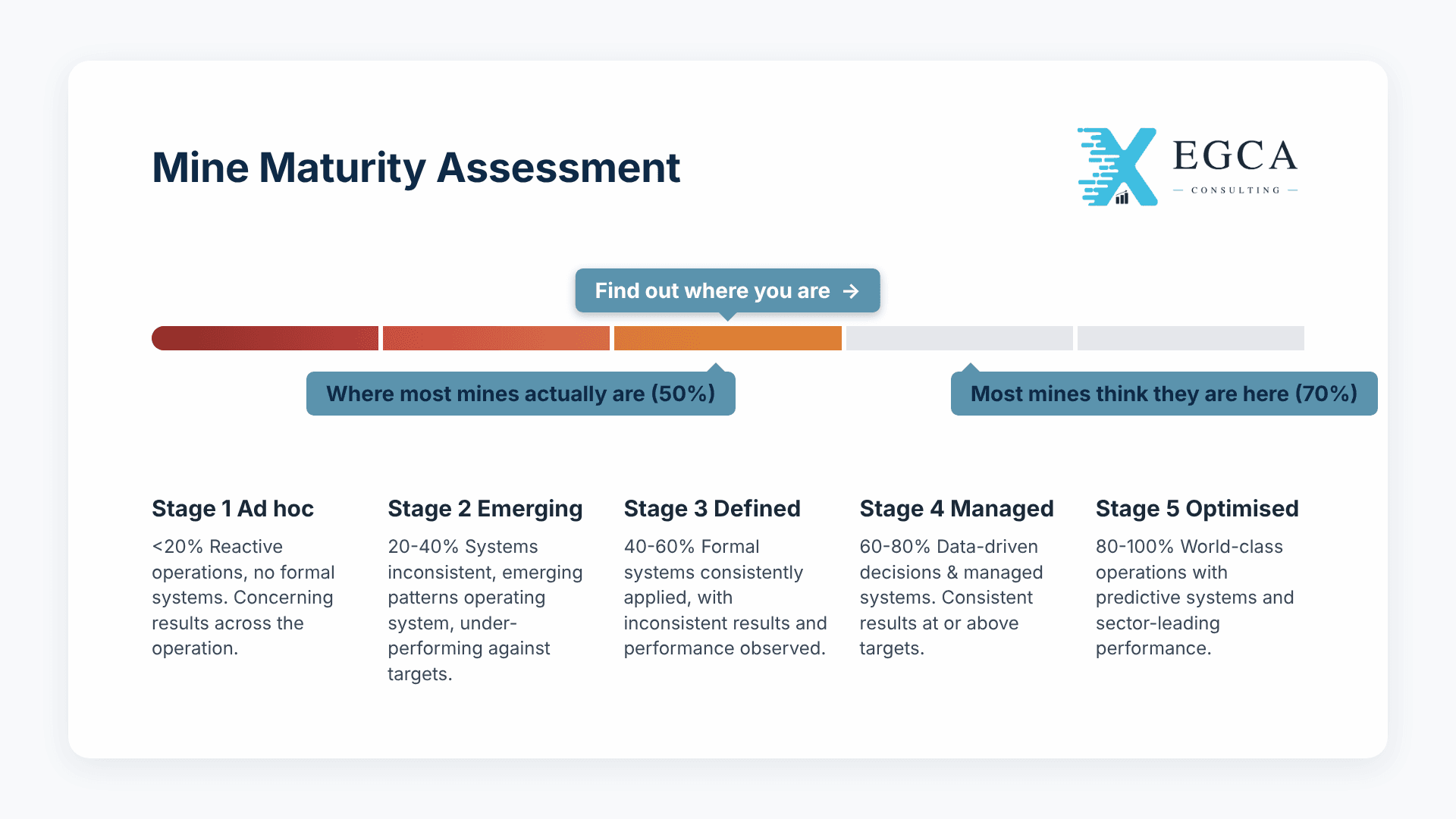
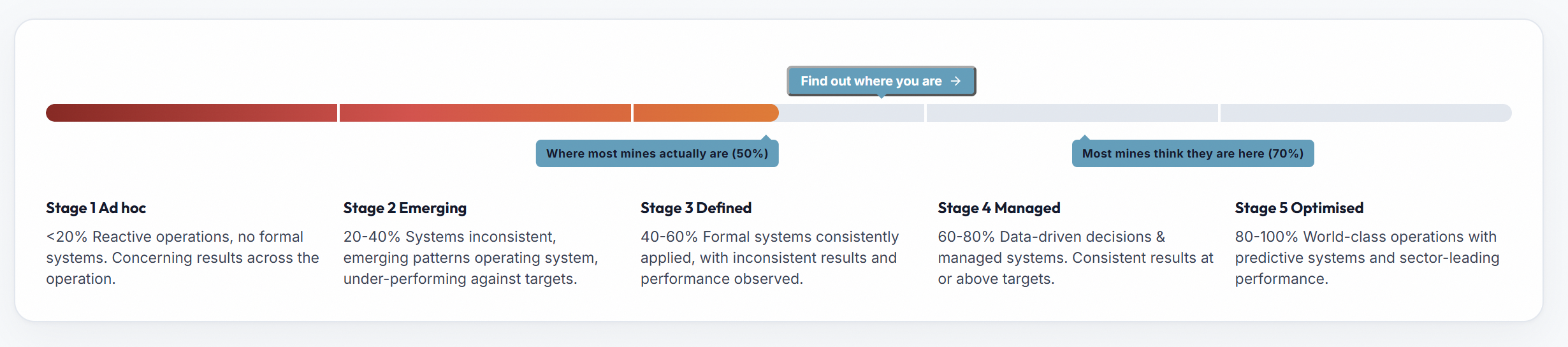
The standard five-level scale (ad hoc, emerging, defined, managed, optimised) is a ladder of repeatability. The higher an operation sits, the less its results depend on who happened to be on duty for the day.
That distinction matters to a COO for a simple reason. Two shafts can post the same cost per tonne in a quarter and be in completely different positions of operational maturity. One is at the ceiling of an immature system that is quietly consuming its people. The other is at the floor of a mature system that is about to compound. The KPI cannot tell them apart, but a well-measured maturity profile can.
It also matters because maturity is leading, and performance is lagging. A section that has slipped from "defined" back to "ad-hoc" in its planning will show it in the tonnes three to six months later, by which point the explanation on the monthly report will be about ground conditions.
This is not a new idea - mining is just late to it...
The five-level maturity scale is nearly forty years old. In 1987 Watts Humphrey at Carnegie Mellon's Software Engineering Institute published a report defining five levels of process maturity — Initial, Repeatable, Defined, Managed and Optimized — which became the Capability Maturity Model in 1991. The US Department of Defense funded it because it could not tell, from proposals and promises, which software contractors would actually deliver. The same five levels were later adopted into ISO/IEC 15504 and into the Object Management Group's Business Process Maturity Model, applied to processes in general rather than software alone.
Humphrey was clear-eyed about what the scale was. In a later interview he described it as an indicator of whether an organisation was following the right kind of practice rather than a measurement of the organisation itself - in his words, essentially a motivational framework (InformIT interview, part 20). His view was that a maturity level is a diagnosis and a direction, not a certificate.
Mining already lives with one maturity model, whether it calls it that or not. Patrick Hudson's safety culture ladder (pathological, reactive, calculative, proactive, generative) was developed in 1999 and formalised by Parker, Lawrie and Hudson in 2006, and was built into the oil and gas industry's Hearts and Minds programme in 2010 (Safteng summary). Any HSE manager in the industry can place their operation on it without thinking too hard about it. The question this post is really asking is why the same discipline stops at the safety department.
Maintenance has its own version. The Institute of Asset Management's maturity scale grew out of the one built for BSI PAS 55 in 2004 and now underpins the SAM+ self-assessment used for ISO 55001 gap analysis, with a generic scale that runs from Innocence to Excellence across 39 subject areas (IAM, Pathway to Excellence). Reliability engineers use it. Their colleagues in planning, processing and commercial generally do not use anything equivalent.
Where mining has adopted maturity thinking beyond safety and assets, it has been almost entirely about digital. Deloitte's 2024 assessment surveyed operational, digital and IT leaders across a set of mining companies and scored them across four categories (Deloitte). Nokia and ABI Research scored the industry's IT maturity at 61.9 out of 100 on their Industry 4.0 index (Nokia Bell Labs). These are useful. They are also narrow: they measure the maturity of the technology layer, not of the operation it sits on. A mine can be digitally advanced and operationally ad hoc, and the digital score will not tell you.
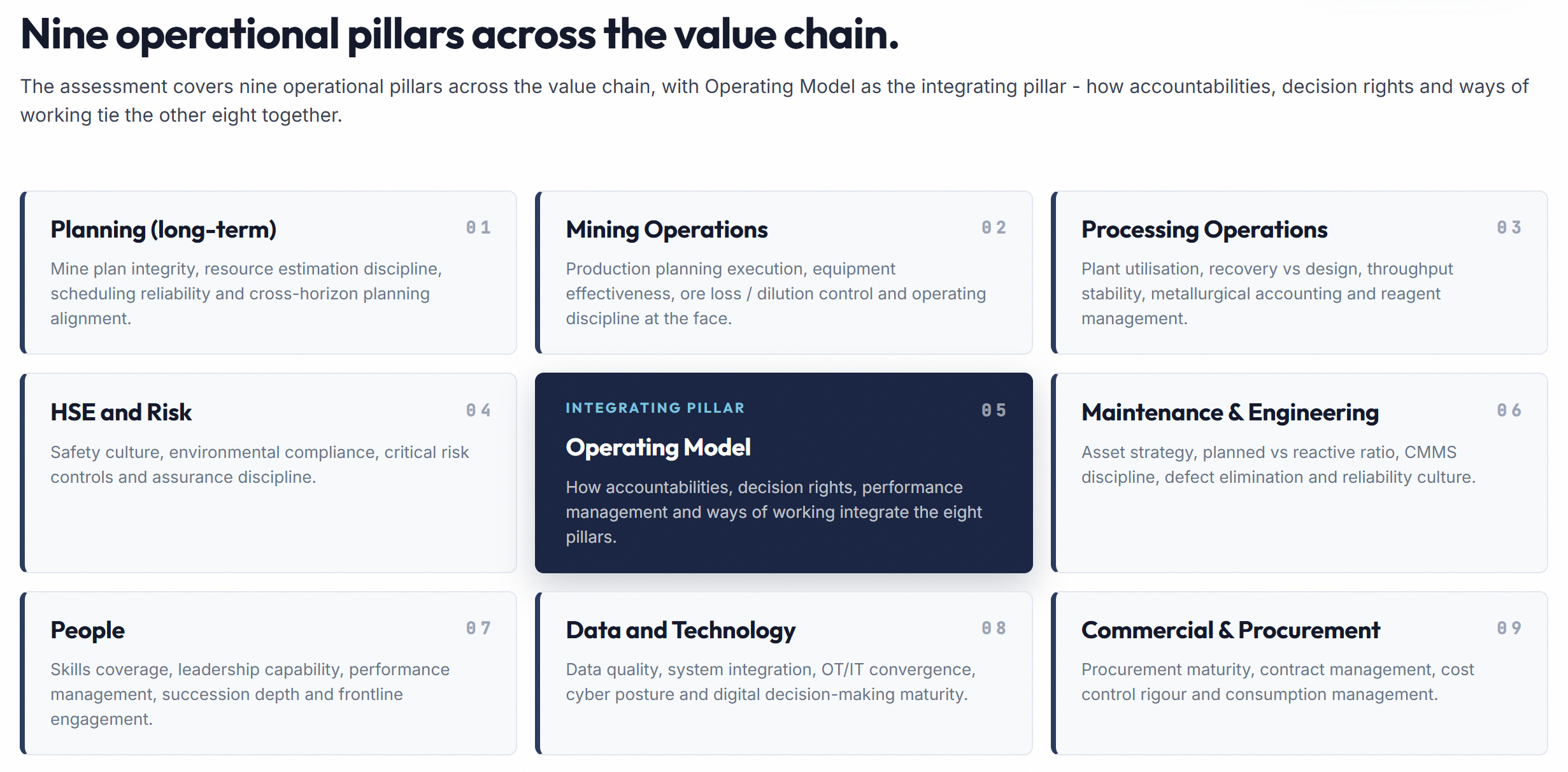
What is missing is the whole-of-operation view: planning, mining, processing, maintenance, commercial, data and systems, people, HSE and the operating model that binds them, on one scale, at one point in time.
What maturity models cannot do, and the problem nobody likes to mention...
Two caveats, before the case for measuring maturity gets ahead of itself.
First, maturity models are better at describing where you are than at telling you where to go. A systematic review of ten business process maturity models found they handled the descriptive job adequately but largely failed the prescriptive one, offering little guidance on which level is desirable or how to reach it (Röglinger, Pöppelbuß & Becker, 2012). This is a real limitation and it should shape how the results are used. Level 5 everywhere is not the objective. A shaft with four years of life left should not be optimising its long-term planning; it should be defined and managed where it matters and ad hoc where it does not. The value of the profile is in the prioritisation, not the score.
Second, and more uncomfortable: a single person's maturity rating is close to noise. The World Management Survey, which has scored management practices at more than 11,000 plants across 30-plus countries since 2004, uses double-blind interviews precisely because self-report does not work. When the researchers formally tested whether firms could assess their own practices, they found managers' self-scores showed no link to performance, while the independent scores correlated well with productivity and profitability (Van Reenen, IGC; Bloom, 2018). Managers also consistently overrated the management performance of their own firms (Bloom et al., 2007) - something we are seeing as well.
Read that as a warning about every maturity workshop where the top team scores itself on a Friday afternoon. The output is a portrait of the team's confidence, not of the operation.
But it also points to the solution. If one rater's score is mostly optimism, the answer is not to abandon the question but to ask it of many people at once, at different levels and in different departments, and then to treat the disagreement as the data. The mean maturity score of a mine is the least interesting number the exercise produces. The spread is where the diagnosis lives, and where the right thinking and experience can guide management towards meaningful interventions.
A mine usually has two gaps, and they need different medicine...
Once you measure maturity across the whole operation and across the hierarchy, two patterns show up that no single score can reveal.
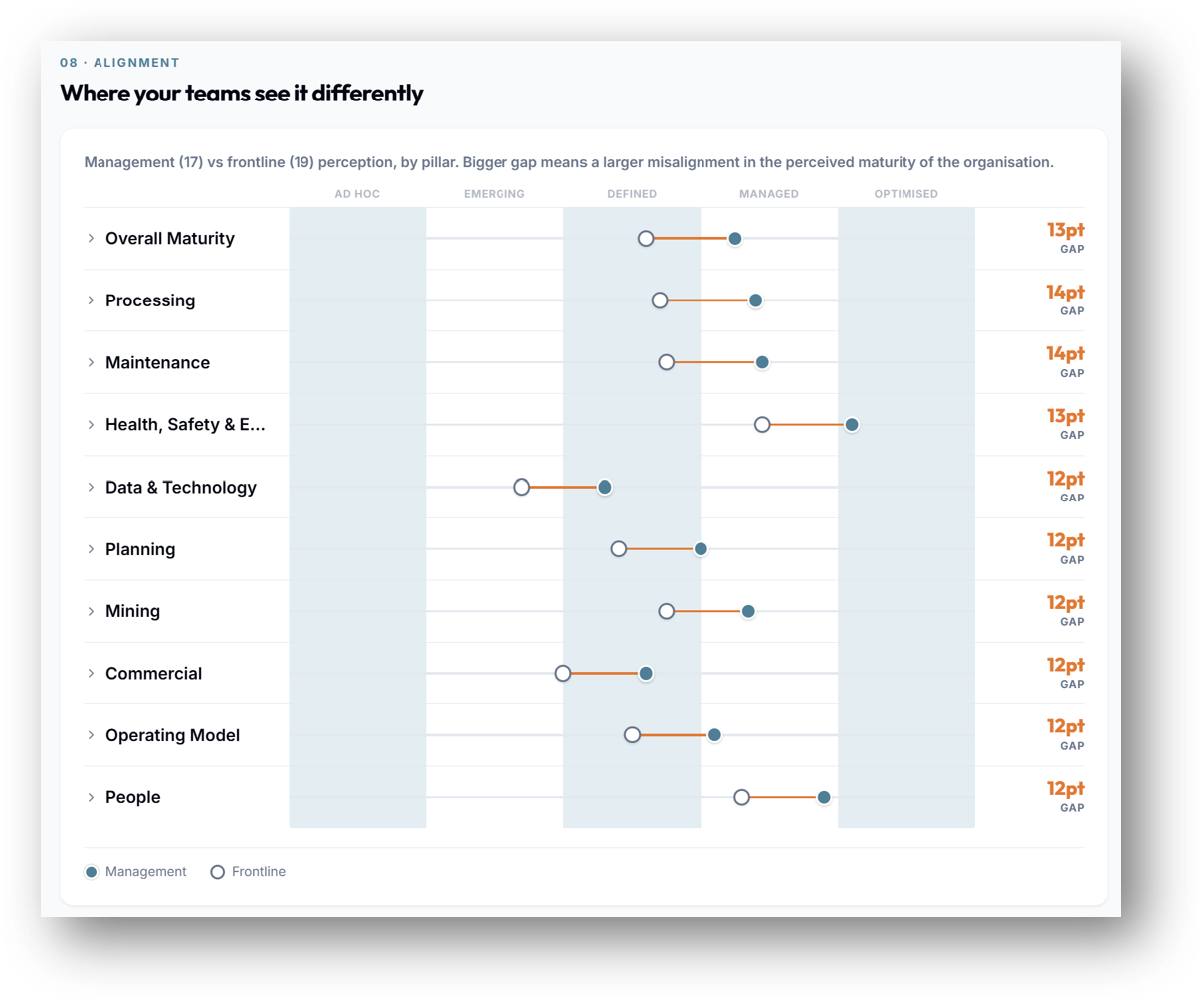
The vertical gap is the distance between what management believes the operating system is and what the frontline experiences it as. This is the GM and the shift boss from the opening. It is not a mining peculiarity. Across frontline industries the pattern is consistent and, by recent measures, widening: in a 2026 survey of roughly 5,700 frontline workers and leaders, only 42% of frontline workers said leaders understood the challenges they faced, down from 62% two years earlier (Dayforce / Hanover Research). Other research finds the further a respondent sits from the frontline, the more positive their view of it (Axonify, via CXM). These are vendor-commissioned surveys and should be read as directional, but the direction is not in doubt.
In one early deployment of our own assessment, management rated the operation more mature than the frontline did on every one of the nine pillars, with the largest gap on the operating model itself. We expected a gap. We did not expect it to be universal. A gap that size on operating model is a specific finding: the structure, roles and decision rights that management has designed are not the ones the frontline is working within, or at least not the ones they default to using under pressure.
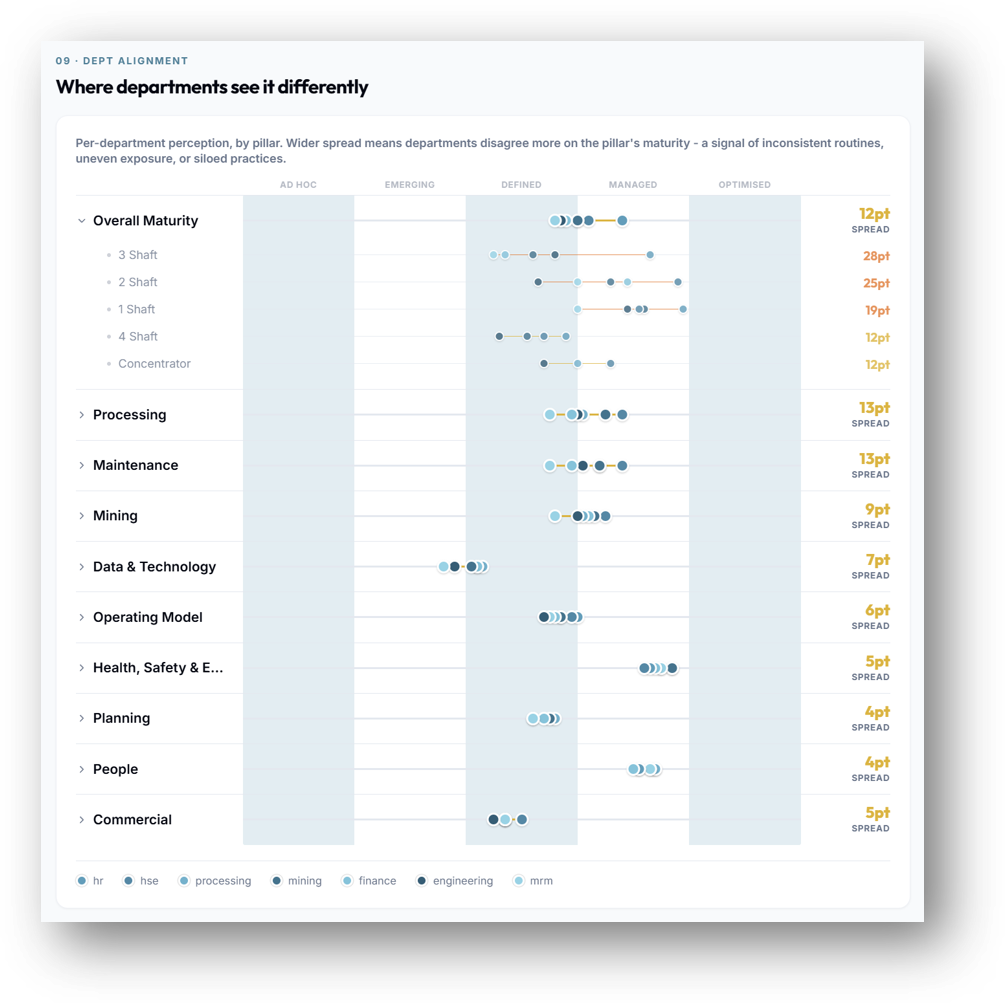
The horizontal gap is the variation between departments. Mining at Defined, processing at Emerging, maintenance at Managed, commercial at Ad hoc. This is the pattern of a site that is not one operation but five, each with its own planning horizon, its own definition of a good day and its own view of who is to blame for a bad one. The handovers between them - the plan to the face, the face to the plant, the plant to the stockpile, the breakdown to the planner - are where the tonnes leak out each day.
The two gaps diagnose different diseases. A large vertical gap with a small horizontal one is a cascade problem: the system exists, is reasonably coherent across functions, and is simply not reaching the face. A large horizontal gap with a small vertical one is an interface problem: each department has a system its own people recognise, and the systems do not talk to each other. Many sites have both, but almost none can tell which one they have and which one is most urgent to address.
What does an exco do with this...?
The practical value of measuring maturity this way is that it tells you which intervention not to run - it helps with real prioritsation of effort for precious management time.
A cascade problem does not need a new operating model, a new planning system or a reorganisation. It needs the existing one to reach the face: supervisor routines, visual management at section level, a short-interval control cycle that the shift boss owns, and a management team that spends its time checking the cascade rather than redesigning the top of it. Spending a year and a consulting budget on a new operating model here is the most common and most expensive mistake in the industry, because it produces a better design that still does not make it to the coalface.
An interface problem is the opposite. More cascade discipline will make each silo better at being a silo. What it needs is integration: a single planning horizon the mine, plant and maintenance teams all plan to, shared definitions of the handover points, and decision rights that sit at the interface rather than on either side of it. Here the operating model work is the right work.
The third case (ie large gaps on both axes) is the signal to stop and stabilise before transforming. An operation that is both fragmented and disconnected from its own frontline will not absorb a transformation programme...it will consume it.
None of this requires a sophisticated instrument to understand. It requires the willingness to ask the whole operation the same questions at the same time and to take the disagreement seriously rather than averaging it away. That is the real significance of measuring maturity: not the number, but the conversation the number forces between the people who designed the system and the people who run it.
Where to start
If the opening scene sounded familiar, the first step is simply to find out how wide the gap is on your own site. EGCA has built a structured nine-pillar assessment to do exactly that, surveying management and frontline across the operation and reporting the vertical and horizontal gaps alongside the maturity profile. You can read more at minematurity.com. But the point of this post stands with or without it: a mine does not have only one maturity score, and the distance between its scores is the most useful thing management can know about where their focus should be...