
The board on the wall
We go back to client sites six months after an engagement to check what has been sustained. Not everything remains in place, and when it slips, the reason is usually the same.
On one of these health-check visits, the visual board we had rolled out (this was before live dashboards became commonplace) hadn't been updated in weeks. The KPIs on it were still the right ones: the input metrics that drive the production numbers the Exco and Board care about. Making those visible had been central to embedding the change. The board was simply no longer being filled in.
Nobody had decided to stop. There was no meeting where the new way was voted down, and nobody I spoke to was against it. It had stopped being asked about, and within a few months the operation had settled back into the shape it knew.
I've seen this often enough that I no longer call it failure. It's decay. In the mines, plants and other heavy operations my team and I work in, decay is a far more common reason that change doesn't stick than anyone resisting it outright.
Nobody resisted...everyone moved on.
Ask a room of leaders what share of change programmes fail and someone will say 70% or more. The figure turns up in textbooks and board packs, but it has no evidence behind it. In 2011 Mark Hughes of the University of Brighton traced five published versions of the claim back to their sources and found nothing empirical underneath.
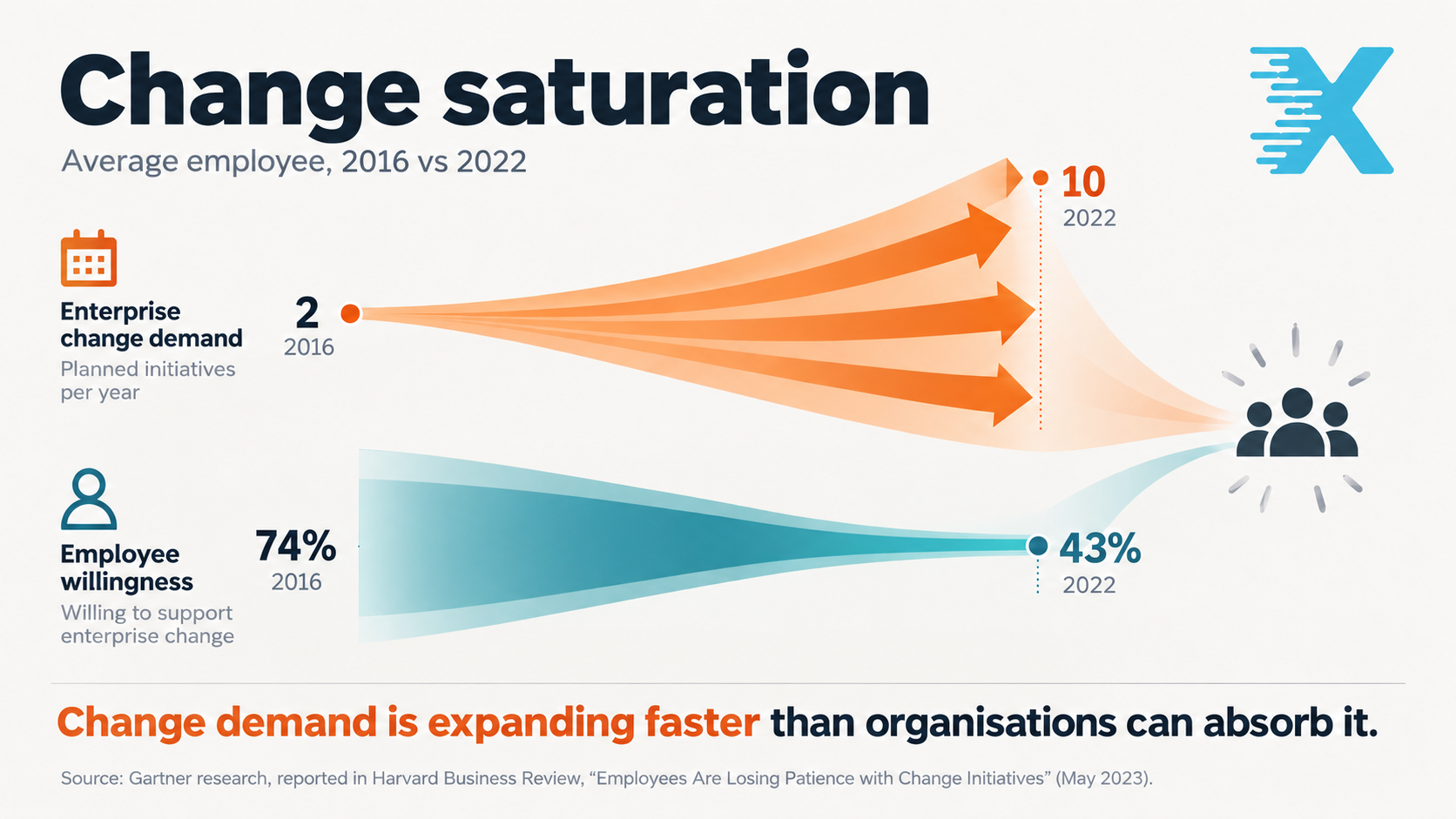
The more useful numbers come from Gartner. In 2016 the average employee went through two planned enterprise changes a year: restructures, system replacements, culture programmes. By 2022 it was ten. Over the same period, as Gartner's researchers reported in Harvard Business Review, the share of employees willing to support enterprise change fell from 74% to 43%.
That points less to people resisting change than to people rationing their attention and effort across too many well-intended ones. Your brilliant initiative isn't judged on its merits alone, it's judged as the seventh thing pushed through this year.
Every change goes through the same narrow door...
In a mine or a plant, almost every change ends up in the same place: the frontline supervisor's shift. The section manager, shift boss or production supervisor runs the new handover, captures the new data and holds the new conversation, while still getting the tonnes out safely.
Look at it the way you would look at a production line. Head office can launch as many initiatives as it likes, but the rate at which the operation absorbs them is set by its bottleneck, and that is usually a few hours of supervisor time per shift. Add a tenth initiative and you don't get ten partial successes, the supervisor is subtly choosing which two to do properly, if any, and the rest decay.
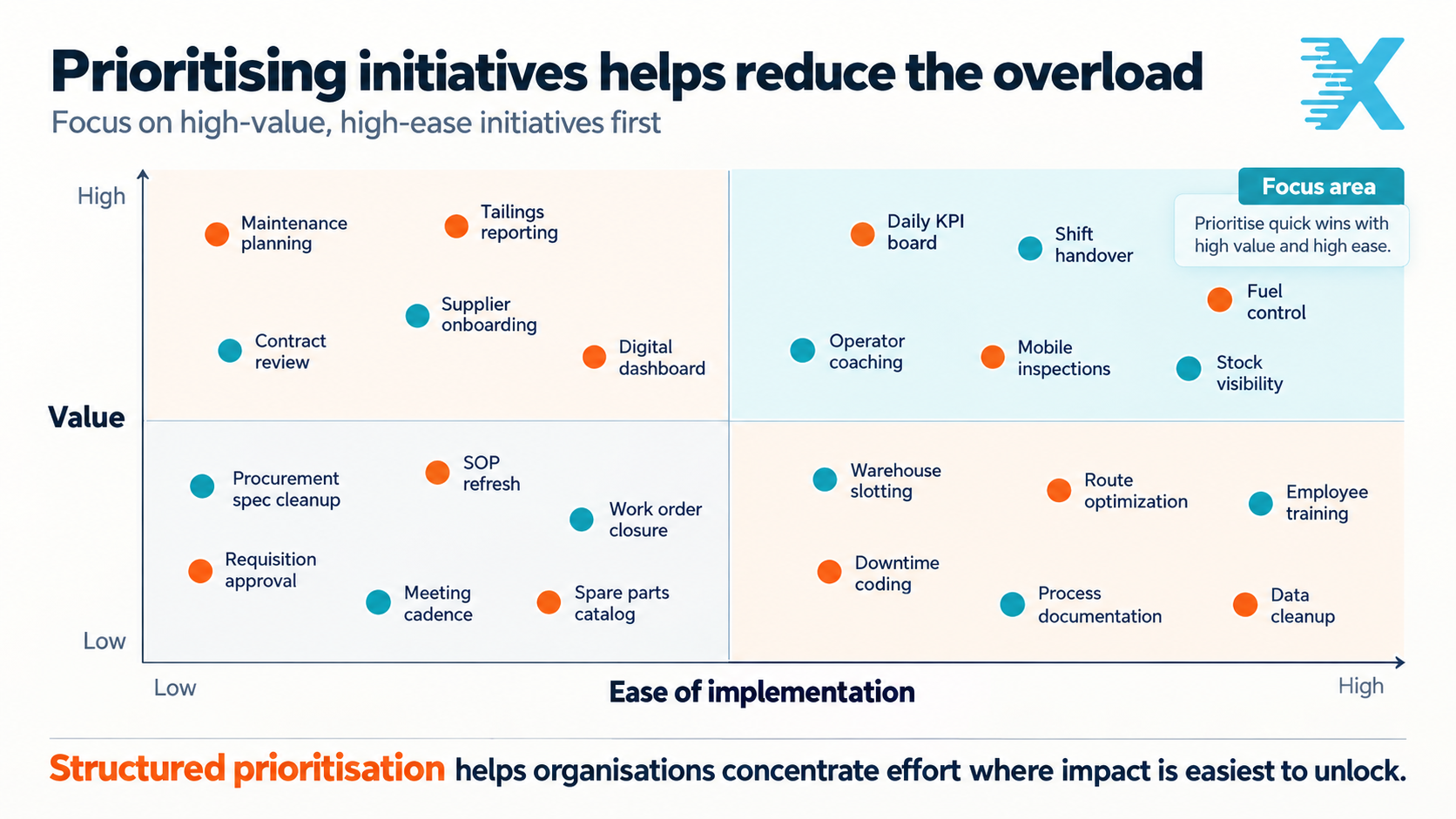
A few years ago my team was asked to set up an operational war room for continuous improvement at a major industrial operation. Before proposing anything new, we counted the improvement initiatives already running. There were 100: a hundred "in progress, signed off" initiatives from different sources and layers of management, with almost no prioritisation to help teams decide what to focus on.
A list of 15 or 20 looks more disciplined, but the count is the wrong test. List every active initiative that asks something of one supervisor role, estimate the minutes per shift each one needs, and add them up. If the total is more than the time that role actually has, the list is too long, whatever its length. Furthermore - it's critical to properly evaluate which initiatives achieves the best ROI for effort - whether that's revenue, recuded cost, improved efficiency or improved safety. Initiatives should be prioritised when the move the dial in what matters to the business.
Change lives in routines, not in heads...
Change that lasts doesn't live in people's heads. It lives in the routines the operation runs every day without thinking: the shift handover, the morning production meeting, the measures on the GM's weekly report, etc. The management operating system (MOS) has to carry the change, and the managers who run that system have to own it all the way to the frontline.
Training fades and communication campaigns fade faster. What keeps a change alive is demand pull: someone senior asking for it, every time. I often say that what interests my boss fascinates the hell out of me, and it rings true for most organisations. If the manager asks about it at the daily meeting, the supervisor cares. If the supervisor cares, the crew cares.
Demand pull only works if supervisors understand why the change deserves one of their few slots. At a large open-pit operation, we needed production shifts to focus on a KPI that seemed obvious but wasn't being tracked, and whose importance had never been made clear to shift bosses. We did the analysis to prove the value of moving it, and walked the line managers through it so they could explain it to their crews. Then we made it a hard-copy chart that every shift supervisor completed at the end of shift, and turned lowering the number into a contest between shifts.
Mine throughput rose by nearly 15% over 3 months. Getting there took better start-of-shift resource planning from supervisors, and a shared understanding with their crews of why the number mattered.
Switch something off...
New ways of working seldom replace ones that have been in use for years. They get added beside them, or used for a while and then dropped. The new system goes live and the planner keeps the old spreadsheet, just in case. The new dashboard launches and the old morning report is still printed, or the whole reporting cycle carries on in parallel in WhatsApp or Telegram groups. For a while both run. Then a bad week arrives, people fall back on what they trust, and the old way wins.
My team saw this at a major industrial client, where we rolled out a live dashboard to track asset uptime and maintenance status. Millions had been spent to make live tracking and incident reporting possible at scale. In the first crunch week, full of fire-fighting and safety incidents, a fleet worth billions went back to being managed through WhatsApp groups as if nothing had changed.
So for every change, decide what gets switched off, and switch it off on a set date. Retire the report. Cancel the meeting. Take the old form out of the system. It feels heavy-handed, but it does two things at once: it removes the fallback, and it frees the supervisor time the new way needs.
Three questions for your operation...
Answer these honestly:
How many initiatives are landing on your middle managers and frontline supervisors right now, and how many minutes per shift do they add up to?
For the last change you launched, what did you switch off?
Which recurring meeting or measure will keep it alive after the project team has left?
Back at the site with the out-of-date board, what would I do differently? I would spend more time embedding the routines around it and building demand pull from the management layer, so the board was used because managers asked for it. We now build that into how we hand over before we leave a site.
If you'd like to discuss how to cut your long list of priorities down to what really matters in your business, reach out for a no-nonsense conversation with our leadership team.
Sources
Hughes, M. (2011). Do 70 per cent of all organizational change initiatives really fail? Journal of Change Management, 11(4), 451–464.
Gartner (2023). Gartner Business Quarterly, Q1 2023.
Harvard Business Review (2023). Employees Are Losing Patience with Change Initiatives.